

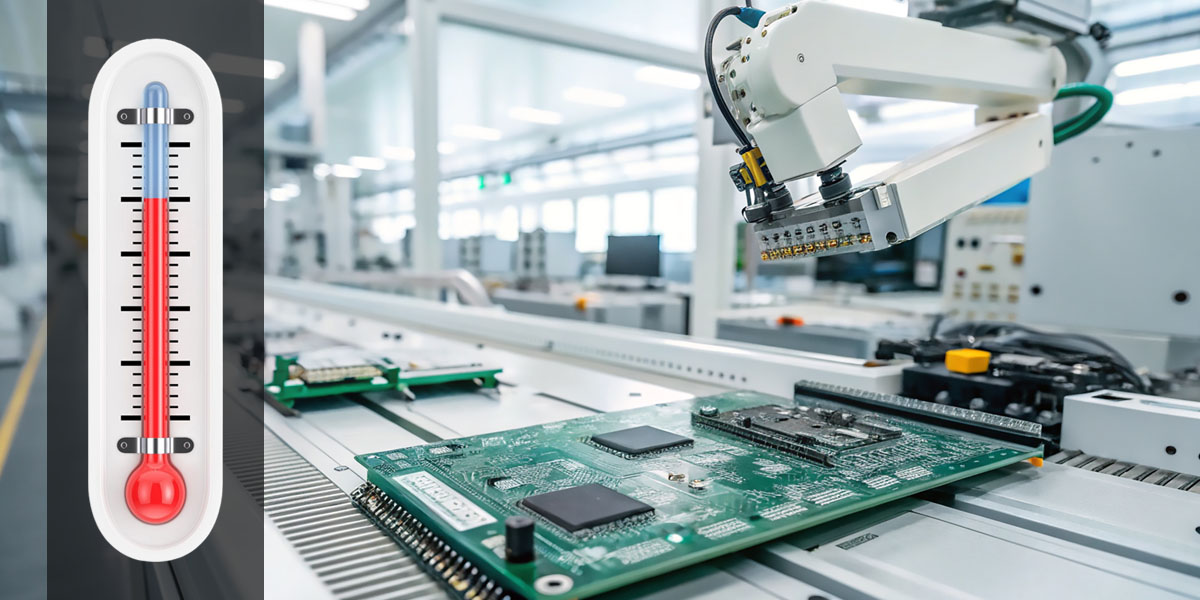
The Definitive Guide to High-Stakes Industrial Thermal Management and Decarbonization
In the electronics manufacturing sector, thermal management is the silent arbiter of profit. Whether it is the microscopic world of semiconductor fabrication or the high-speed assembly of multi-layer PCBs, heat is the most significant environmental factor influencing chemical reaction rates, material structural integrity, and electronic carrier mobility.
As we enter the era of Industry 4.0 and the Net-Zero mandate, the traditional methods of heating—fossil-fuel-fired boilers and inefficient resistive heaters—are no longer just environmentally “dirty”; they are technically inadequate. Trigen DC provides the bridge between these two worlds: delivering the sub-degree thermal precision required for modern electronics through electrified, high-efficiency heat pump technology.
The physics of electronics is inherently thermal. Every component has a Coefficient of Thermal Expansion (CTE), and when materials with different CTEs are bonded together, temperature fluctuations act as a mechanical stressor.
During wafer processing, even a $0.5^{\circ}\text{C}$ deviation can lead to non-uniformity in the photoresist layer or inconsistent dopant diffusion. This results in “binning” issues, where chips from the same wafer have vastly different performance profiles.
Even minor deviations at these high temperatures significantly alter electrical characteristics.
A Printed Circuit Board (PCB) is made of glass-reinforced epoxy (FR4) and copper. Since copper expands faster than FR4, rapid temperature fluctuations during plating or etching can cause micro-cracks in traces or via holes, leading to long-term reliability issues.
The following PCB processes can be effectively catered to using TriGeN’s industrial heat pump systems:
These temperature ranges fall well within the operational capability of industrial heat pumps. Maintaining stability within ±1°C is critical for uniform deposition thickness and consistent process quality — which can be achieved through precise heat pump-based thermal control.
In SMT operations, the viscosity of solder paste is highly sensitive to ambient temperature. If the temperature is too high, the paste can slump and cause solder bridging. If too low, it may not wet properly, leading to cold joints.
This controlled environment requirement can be effectively catered using TriGeN’s industrial heat pump systems for precise HVAC and thermal regulation.
Even a 2–3°C temperature drift can significantly impact paste rheology. Industrial heat pumps ensure stable temperature control, supporting consistent soldering quality and process reliability.
The “Liquidous” phase of solder requires a very specific dwell time. If the thermal system lacks precision, the intermetallic layer—the chemical bond between the solder and the pad—will either be too thin (weak bond) or too thick (brittle bond).
Precision across heating zones is essential.
The cost of poor thermal control is measured in yield loss.
In high-density assemblies, heat-induced warping can snap the tiny solder balls under a Ball Grid Array (BGA) package.
Thermal cycling due to poor control leads to “creep” and eventual fatigue of the joint.
Typical operating thermal cycles: -40°C to +125°C (automotive-grade electronics)
“Popcorning” occurs when moisture trapped inside a component or PCB rapidly expands into steam during sudden heat exposure, causing internal rupture. Moisture-induced failures typically occur when components are subjected to >220°C reflow temperatures without proper pre-baking.
The required pre-bake process can be effectively catered to using TriGeN’s industrial heat pump systems:
Industrial heat pumps can provide stable, energy-efficient thermal control for pre-baking applications, ensuring moisture removal while supporting decarbonization and process reliability.
An electronic device that runs $10^{\circ}\text{C}$ hotter than its design limit typically sees its operational life halved (Arrhenius Equation).
PCB fabrication is a chemical-intensive process in which temperature dictates the reaction rate.
Lamination
Bonding layers of a multilayer PCB requires a specific “ramp-up” and “soak” period under high pressure. Precise control ensures the resin flows correctly into all crevices without air pockets.
Electroplating requires maintaining chemical baths at constant temperatures to ensure uniform metal thickness across the PCB.
The following plating processes can be catered to using TriGeN’s industrial heat pump systems:
Precise temperature control ensures consistent deposition quality and process stability.
After the solder mask application, thermal curing is required. Uneven heating can cause surface tackiness or discoloration.
This curing process can be effectively supported using industrial heat pump systems:
Industrial heat pumps can provide controlled, energy-efficient heating for drying and curing operations, ensuring uniform results and improved reliability.
A modern reflow oven has between 7 and 12 heating zones.
Thermal uniformity is critical to ensure that large, high-mass components (such as transformers) and small components (like resistors) reach the required temperatures consistently during reflow.
The following reflow heating stages can be effectively supported using TriGeN’s industrial heat pump-integrated thermal systems:
Precise and stable temperature control across these zones ensures uniform heating, reduces thermal stress, and improves solder joint reliability.
The transition from liquid to solid must be controlled to prevent internal stresses.
Controlled cooling: 2°C to 4°C per second
Semiconductor “Fabs” are perhaps the most thermally sensitive environments on earth.
Chemical Vapor Deposition (CVD)
Gases are reacted at specific temperatures to deposit thin films. A slight drift in temperature changes the film’s thickness and electrical properties.
CVD temperature ranges: 300°C to 900°C depending on material system
Cleanrooms require continuous 24/7 HVAC operation to maintain strict environmental control. Air is first cooled to remove moisture and then reheated to the exact setpoint of 22°C ± 0.1°C.
This precise climate requirement can be effectively catered using TriGeN’s industrial heat pump systems with integrated heat recovery.
Industrial heat pumps enable simultaneous cooling and reheating, ensuring tight temperature and humidity control while significantly improving energy efficiency and supporting decarbonization goals.
Before shipping, high-reliability electronics undergo Burn-In Testing. This involves running the device at its maximum rated temperature for hours or days to trigger “infant mortality” failures.
If the test chamber’s temperature is not precise (typically ±1°C control required), the test is either invalid or damaging to the good components.
When evaluating a thermal system for electronics, look for these “Non-Negotiables”:
Specification | Requirement for Electronics | Why it matters |
Temp Stability | $\pm 0.5^{\circ}\text{C}$ | Prevents CTE-induced micro-cracking. |
Response Time | < 30 Seconds | Necessary for high-speed SMT lines. |
COP (Heating) | > 3.5 | Ensures the payback period is under 2 years. |
Control Interface | Modbus / BACnet | Essential for Industry 4.0 / SCADA integration. |
Refrigerant | Low GWP (R1234ze / R290) | Future-proof against environmental bans. |
Operating Cost Comparison
In India, the cost of generating 1,000 kcal of heat:
Long-Term Lifecycle Cost Benefits
Beyond energy, Trigen DC systems have lower O&M (Operations & Maintenance) costs. There are no burners to clean, no fuel tanks to manage, and no high-pressure boiler certifications to maintain every year.
Operating Cost Comparison
In India, the cost of generating 1,000 kcal of heat:
Long-Term Lifecycle Cost Benefits
Beyond energy, Trigen DC systems have lower O&M (Operations & Maintenance) costs. There are no burners to clean, no fuel tanks to manage, and no high-pressure boiler certifications to maintain every year.
Trigen DC is not just a manufacturer; we are an Engineering Partner.
In the competitive landscape of electronics manufacturing, Thermal Precision is no longer a luxury—it is a survival trait. As global supply chains prioritize “Green Electronics,” the shift toward electrified, high-precision thermal systems is inevitable.
Trigen DC provides the technology to make your facility more precise, more profitable, and ready for a Net-Zero future.
Don’t leave your yield to chance. Consult with TriGeN’s thermal engineers today to design a system that works with the precision of the electronics you build.
Yes. TriGeN’s ultra-high-temperature range is specifically designed to hit these targets where standard commercial heat pumps fail.
Absolutely. Our systems are designed for easy integration with existing chilled water or hot water loops, often requiring minimal downtime for the switchover.
By replacing fossil fuels with electrified heat pumps, we provide the documented carbon reduction (tonnes of $CO_2$ saved) required for you to claim and trade Carbon Credits.
In electronics manufacturing, thermal stability isn’t just a metric—it’s the foundation of yield. A variation of even $\pm0.5$°C can trigger CTE (Coefficient of Thermal Expansion) mismatches, leading to micro-cracking, solder fatigue, and “popcorning” delamination.
Key Thermal Benchmarks & Risks:
The Bottom Line: For Industry 4.0, high-efficiency thermal control is the only way to balance Net-Zero goals with maximum profitability.