

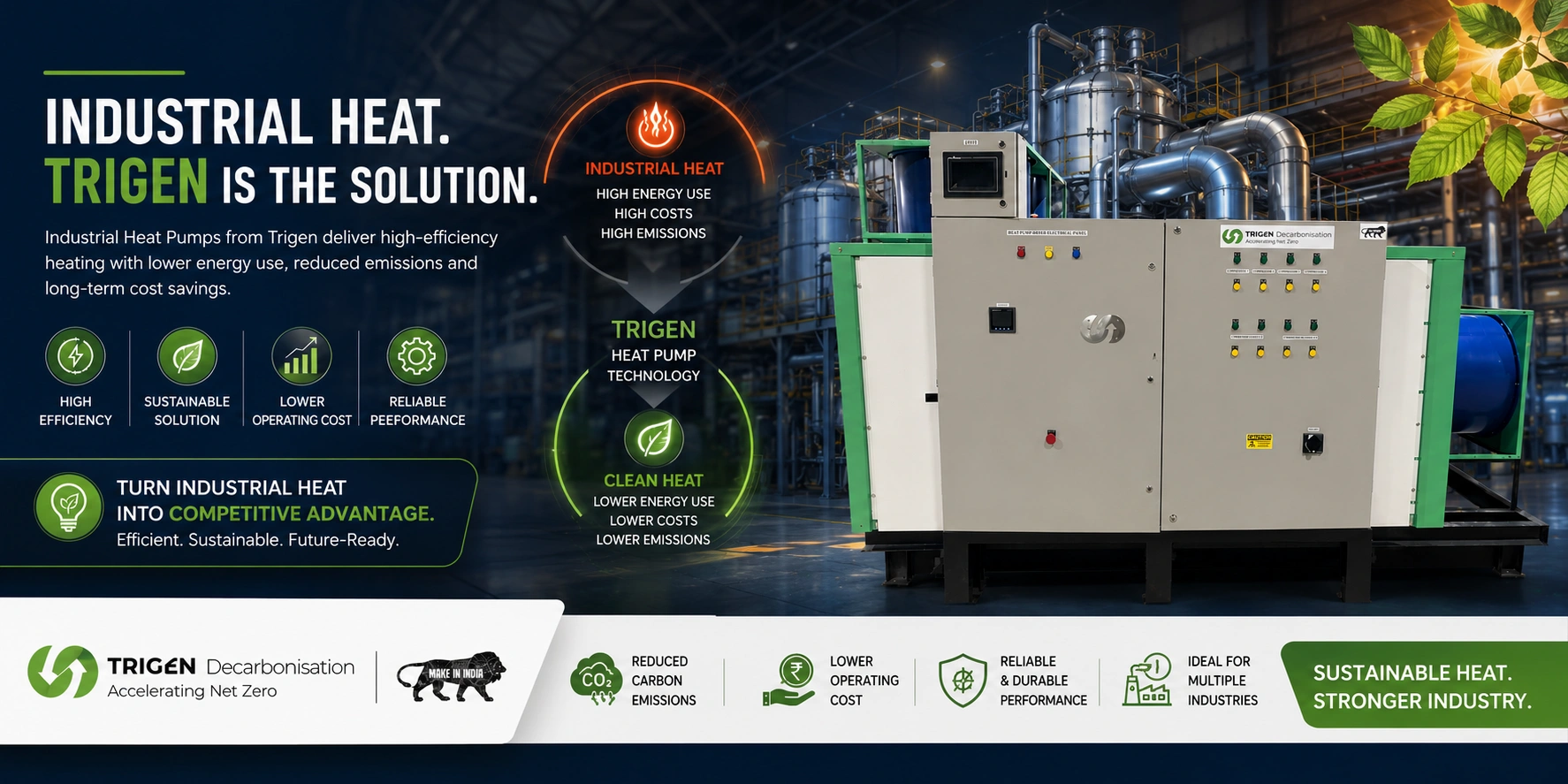
India’s manufacturing sector is at a turning point; it is evolving rapidly. As the country accelerates its push toward eco-friendliness and sustainable industrial growth, the focus has shifted from merely reducing emissions to transforming core industrial processes—and industrial heat is at the heart of this transformation.
Heating processes consume over 40% of the total energy used in manufacturing industries in India, much of it sourced from fossil fuels. This not only inflates operational costs but also drives carbon emissions. Enter industrial heat pumps—a breakthrough technology offering sustainable heating for factories with remarkable energy efficiency.
At TRIGeN Decarbonisation Pvt. Ltd, we are leading the charge by introducing advanced industrial heat pump technology for manufacturing, tailored for India’s unique industrial ecosystem.
An industrial heat pump is a high-efficiency system that transfers heat from a lower-temperature source (such as air, water, or waste heat) to a higher-temperature sink, making it suitable for industrial processes. Unlike traditional heating methods that burn fuel, heat pumps use electricity or renewable power sources to move heat rather than generate it.
For every unit of electricity consumed, an industrial heat pump delivers 3 to 5 units of thermal energy — a performance benchmark measured by the Coefficient of Performance (COP). This makes them one of the most effective tools available today for industrial heating decarbonization.
Industrial heat pumps are not a one-size-fits-all technology. Depending on the heat source, process temperature requirements, and facility infrastructure, different types of systems are deployed in different industries.
Vapour compression heat pumps are the most widely used type in industrial applications. They operate on a closed-loop refrigerant cycle — the refrigerant absorbs heat at a low pressure (evaporator stage), is compressed to a higher pressure, raising its temperature, and then releases that heat into the industrial process.
They are best suited for applications requiring process temperatures ranging from 60°C to 120°C and are highly compatible with air-source and water-source configurations. Their high COP and proven track record make them the preferred choice for food processing, textiles, and pharmaceutical industries.
Absorption heat pumps operate on a thermochemical cycle, using a refrigerant-absorbent pair — typically water and lithium bromide or ammonia and water — instead of a mechanical compressor. They are driven by a heat source such as waste steam, exhaust gases, or solar thermal energy rather than electricity alone.
This makes them particularly advantageous for industries that already generate significant quantities of waste heat, as they can recover and upgrade that heat for productive reuse. Absorption heat pumps are well-suited for chemical plants, refineries, and large-scale process industries where high-grade waste heat is readily available.
Hybrid heat pumps combine the strengths of vapour compression and conventional heating systems — or integrate heat pumps with renewable energy sources such as solar thermal — to deliver flexible, resilient, and highly efficient heating across variable load conditions.
They are ideal for manufacturing facilities that experience fluctuating heat demands or operate in regions with variable ambient temperatures. Hybrid systems ensure that operational continuity is never compromised, automatically balancing between heat pump operation and auxiliary heating when required.
Industrial heat pumps are not a one-size-fits-all technology. Depending on the heat source, process temperature requirements, and facility infrastructure, different types of systems are deployed in different industries.
Vapour compression heat pumps are the most widely used type in industrial applications. They operate on a closed-loop refrigerant cycle — the refrigerant absorbs heat at a low pressure (evaporator stage), is compressed to a higher pressure, raising its temperature, and then releases that heat into the industrial process.
They are best suited for applications requiring process temperatures ranging from 60°C to 120°C and are highly compatible with air-source and water-source configurations. Their high COP and proven track record make them the preferred choice for food processing, textiles, and pharmaceutical industries.
Absorption heat pumps operate on a thermochemical cycle, using a refrigerant-absorbent pair — typically water and lithium bromide or ammonia and water — instead of a mechanical compressor. They are driven by a heat source such as waste steam, exhaust gases, or solar thermal energy rather than electricity alone.
This makes them particularly advantageous for industries that already generate significant quantities of waste heat, as they can recover and upgrade that heat for productive reuse. Absorption heat pumps are well-suited for chemical plants, refineries, and large-scale process industries where high-grade waste heat is readily available.
Hybrid heat pumps combine the strengths of vapour compression and conventional heating systems — or integrate heat pumps with renewable energy sources such as solar thermal — to deliver flexible, resilient, and highly efficient heating across variable load conditions.
They are ideal for manufacturing facilities that experience fluctuating heat demands or operate in regions with variable ambient temperatures. Hybrid systems ensure that operational continuity is never compromised, automatically balancing between heat pump operation and auxiliary heating when required.
For every unit of electricity consumed, heat pumps can deliver 3–5 units of thermal energy, making them an ideal fit for industrial heating decarbonization.
Despite significant advancements, India’s manufacturing industry faces persistent challenges:
These hurdles call for industrial energy efficiency solutions that are cost-effective, scalable, and aligned with the net-zero goals.
The integration of heat pumps into factories is not just an upgrade—it’s a transformation. Here’s how:
Heat pumps use less primary energy than traditional systems. Their high Coefficient of Performance (COP) translates into significant savings.
With energy costs comprising up to 30% of total manufacturing expenses, reducing fuel use can save lakhs annually. For instance, a TRIGeN-installed system in a food processing unit cut annual fuel costs by over 40%.
Heat pumps provide precise temperature control, reduce thermal losses, and ensure non-stop operation, enhancing overall productivity.
Switching to electrified heating systems—especially when powered by renewables—contributes directly to industrial electrification solutions and helps meet ESG and net-zero commitments.
From textiles and chemicals to pharmaceuticals and food processing, heat pumps can adapt to a wide range of heating requirements.
At a chemical manufacturing plant in Gujarat, TRIGeN deployed a custom-designed water-source industrial heat pump. Results after 12 months:
“Working with TRIGeN has transformed our energy outlook. The system is seamless, efficient, and future-ready.” – Operations Head, Client Company
The ecosystem for heat pump adoption in India is more favorable than ever:
Waiting could mean missed savings and regulatory setbacks.
Industrial heat pumps are highly versatile and can be integrated across a wide range of manufacturing sectors, including:
Food & Beverage Processing — For pasteurization, sterilization, drying, and cooking processes that require precise and consistent temperature control.
Textiles — For dyeing, washing, and drying operations that demand large volumes of process heat.
Pharmaceuticals — For controlled heating in drug formulation, sterilization, and cleanroom environments.
Chemicals — For reactor heating, solvent recovery, and distillation processes.
Paper & Pulp — For drying and steam generation across production lines.
Dairy Industry — For pasteurization and product heating with strict hygiene standards.
Automotive & Engineering — For surface treatment, coating, and curing processes.
Wherever consistent, clean, and cost-effective heat is required, industrial heat pumps can deliver.
At TRIGeN, we don’t just supply equipment—we deliver end-to-end decarbonization solutions for industries. Here’s what sets us apart:
Every manufacturer is different. At Trigen DC We design customized systems for specific process requirements, ensuring optimal ROI.
Our services include on-site audits, system design, installation, and continuous performance tracking.
We integrate TRIGeN Decarbonisation Technology with cutting-edge heat pump systems and renewable integration strategies.
Our goal is clear: enable Indian industry to thrive sustainably, cut emissions, and become global leaders in green manufacturing.
At TRIGeN Decarbonisation Pvt. Ltd., we understand that every manufacturing facility has unique heating requirements. That is why we offer end-to-end industrial heat pump solutions — from site audits and system design to installation, commissioning, and ongoing performance monitoring.
Customisation — Systems are engineered specifically for your process temperatures, load profiles, and operational schedules — ensuring maximum efficiency and return on investment.
Reliability — Our heat pump systems are designed for uninterrupted industrial operation, providing consistent thermal output with minimal maintenance downtime.
Sustainability — By replacing fossil fuel-based heating with electrified, renewable-ready systems, our solutions directly support your net-zero and ESG commitments.
Industrial heat pumps are no longer optional—they’re essential for any manufacturer aiming to remain competitive, compliant, and eco-friendly at the same time.
At TRIGeN, we’re ready to help your factory make the shift.
Industrial heat pumps are emerging as a key solution to transform India’s manufacturing sector by replacing fossil fuel-based heating with highly efficient, electrified systems. Since industrial heating accounts for over 40% of energy use, heat pumps—delivering 3–5x energy output per unit of electricity—significantly reduce energy consumption, operational costs, and carbon emissions. Technologies like vapour compression, absorption, and hybrid systems cater to diverse industrial needs, from food processing to chemicals.
With proven results such as up to 40% cost savings and rapid ROI, along with growing government support and ESG pressures, heat pumps offer a scalable path toward decarbonization and net-zero manufacturing.