

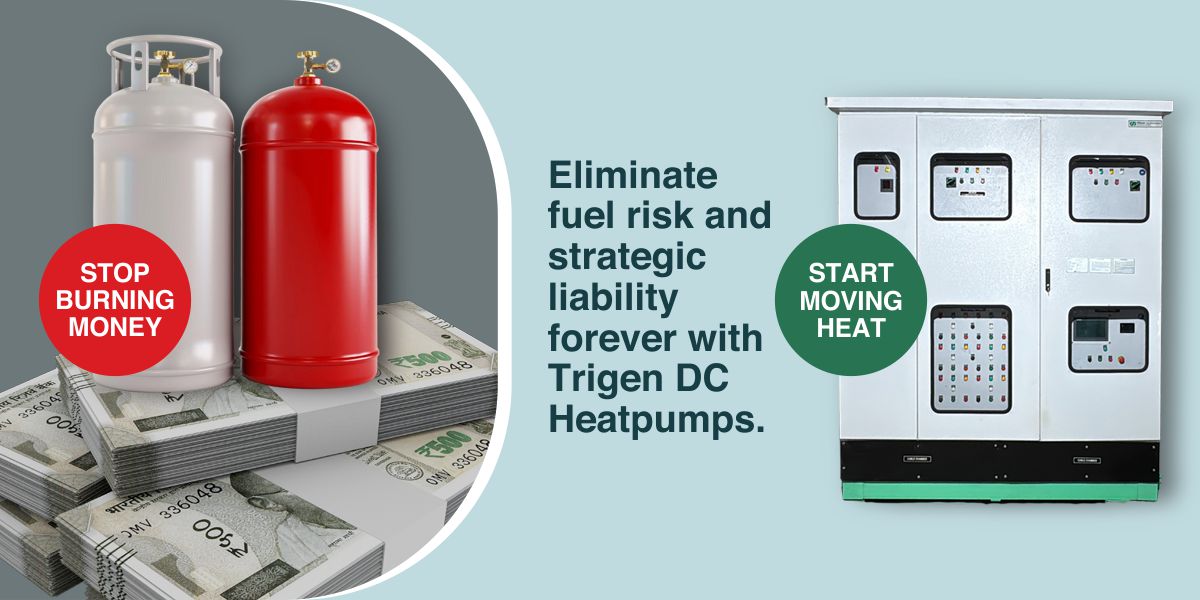
Every day, your facility—whether it is a dairy plant, textile unit, or chemical processor—relies on diesel, furnace oil, LPG, or PNG for process heating, and your benefit is on the external forces. Geopolitical shifts, supply disruptions, and currency fluctuations turn your largest operating expense into a constant variable.
This is more than a financial inconvenience; it is a strategic vulnerability.
The technology to eliminate this uncertainty is already proven and commercially viable: Industrial Heat Pumps. At TRIGeN Decarbonisation, we engineer high-performance systems that transition your process heating from volatile liquid and gaseous fuels to efficient, electricity-driven thermal energy.
The shift to industrial electrification is no longer just a sustainability goal—it is a calculated financial move to secure price certainty and long-term operational resilience in 2026.
For industries relying on LPG, diesel, furnace oil, or PNG, the monthly energy bill is a gamble. The global oil market has seen massive swings—dropping over 40% in 2024 only to rebound sharply under new geopolitical pressures in 2025 and 2026.
In India, industrial users bear the full weight of these fluctuations. Unlike domestic consumers who receive policy protection, commercial enterprises are directly exposed to international crude oil movements and rupee depreciation. As of April 2026, commercial LPG prices have surged by nearly ₹200 per cylinder, driven by volatility in West Asia—a region that supplies over 85% of India’s crude requirements.
The “Strait of Hormuz” factor remains a primary threat to industrial stability. With nearly 20% of the world’s oil passing through this single corridor, any regional tension translates into an immediate price spike in your boiler room.
The precedent is clear: in early 2026, Aviation Turbine Fuel (ATF) hit record highs of over ₹2,00,000 per kilolitre. This volatility illustrates how quickly liquid fuel costs can double, often with no warning, disrupting planned OPEX and eroding quarterly margins.
Switching to industrial heat pumps fundamentally changes your financial risk profile. You move from a globally-priced commodity to a domestically-regulated utility.
Electricity tariffs in India are managed by state regulatory commissions through transparent, public processes. They do not react overnight to geopolitical crises in the Middle East. By transitioning your heating load to an electric heat pump, you gain:
This predictability—independent of the massive efficiency gains—is a critical asset for long-term industrial profitability.
Traditional boilers and furnaces generate heat through combustion. Even high-efficiency modern boilers operate at 65–85% thermal efficiency, meaning 15–35% of your fuel’s energy is lost through flue gases, radiation, and convection before it ever reaches your process.
An industrial heat pump operates on a fundamentally different thermodynamic principle: it moves heat rather than generating it. By using a small amount of electricity to drive a refrigeration cycle, the system captures waste heat or ambient energy and “upgrades” it to the precise temperature your process requires.
The efficiency of this process is measured as the Coefficient of Performance (COP).
This translates to 400% efficiency—a feat physically impossible for any combustion-based system.
The shift from fuel to heat pumps is backed by global and domestic industrial benchmarks:
A common misconception is that heat pumps are only for low-temperature applications. Today’s HTHP technology delivers process heat above 150°C, with ongoing innovations pushing toward 200°C.
This covers the vast majority of requirements across diverse sectors:
For processes it needs extreme temperatures beyond the current HTHP range, hybrid configurations—using heat pumps for pre-heating combined with minimal supplementary heating—still offer a massive reduction in fuel dependency and operational costs.
When evaluating the transition from combustion to electrification, the numbers speak for themselves. Below is a direct comparison between traditional fuel-fired boilers and TRIGeN Industrial Heat Pumps.
| Parameter | Liquid / Gaseous Fuel Boiler | TRIGeN Industrial Heat Pump |
|---|---|---|
| Energy Efficiency | 65–85% (Thermal Efficiency) | 300–500% (COP of 3–5) |
| Primary Energy Source | Diesel, Furnace Oil, LPG, PNG | Electricity (Grid or Renewable) |
| OPEX Predictability | High Volatility (Linked to Crude/Geopolitics) | High Stability (Regulated Utility Tariffs) |
| Carbon Footprint | Significant (Scope 1 Direct Emissions) | Near-Zero (Aligned with RE100/Net Zero) |
| Maintenance Profile | Higher (Burners, Flue Gas, Scaling) | Lower (Solid-state/Refrigeration Cycle) |
| Typical Payback | N/A (Perpetual Fuel Expense) | 12–24 Months (Project Dependent) |
| Strategic Compliance | Risk of Carbon Taxes/BRSR Non-compliance | Future-Proof (ESG & Decarbonization Ready) |
| Energy Circularity | Linear (Heat lost to atmosphere) | Circular (Recovers & Upgrades Waste Heat) |
In the current 2026 energy landscape, sticking with a fuel-fired boiler isn’t just an environmental choice—it’s an acceptance of uncapped financial risk. A heat pump converts that risk into a fixed, manageable utility cost with a clear ROI timeline.
The Indian Industrial Heat Pump market is undergoing a massive structural shift. Valued at over USD 8.8 billion in 2025, the sector is projected to grow at a staggering CAGR of over 40% through 2032. This growth is driven by a simple economic reality: the gap between volatile fossil fuel prices and regulated electricity tariffs is widening.
While industrial equipment is often judged on long-term utility, TRIGeN systems are delivering “best-in-class” financial returns. Across Indian industrial deployments in 2026, we are seeing payback periods as short as 18 to 36 months, particularly in sectors like dairy, chemicals, and textiles.
Even in complex retrofits, a simple payback of under 5 years is the standard. When you factor in a system lifespan of 15–20 years (compared to 10–12 years for high-maintenance boilers), the Internal Rate of Return (IRR) often exceeds 30%.
One unique feature of heat pump economics is that the investment becomes more valuable after it is made.
India’s roadmap to Net Zero by 2070 is no longer a distant vision—it is a live regulatory framework. For industrial leaders in 2026, decarbonization has shifted from a “nice-to-have” PR initiative to a core requirement for operational and financial standing.
The landscape has changed significantly with two major domestic pillars:
By eliminating fossil-fuel combustion, your organization secures five immediate strategic “dividends”:
The Early Mover Advantage: The IEA projects that industrial heat pump adoption must triple by 2030 to meet global climate pledges. Companies that transition now capture government incentives and green capital today; those that wait will be forced to transition later under the pressure of penalties and higher market competition.
At TRIGeN Decarbonisation Pvt. Ltd., we recognize that transitioning your thermal infrastructure is a high-stakes decision involving capital, process continuity, and technical risk. Our mission is to eliminate that risk through an evidence-based, turnkey approach that guarantees performance.
We don’t just sell equipment; we engineer outcomes. Our four-stage deployment process ensures your system is optimized for your specific facility:
We are pioneers in Ultra-High Temperature Heat Pumps (HTHP). While many competitors struggle above 80°C, TRIGeN deployed its first steam generating, 125 Deg C Heat pump unit, 24 months back and have since deployed standalone systems generating Hot water/ Steam/Hot air at 135 Deg C and above
We currently serve mission-critical processes across:
If your facility uses heat at any stage of production, you are currently exposed to fuel price volatility. TRIGeN gives you the tools to electrify, save, and lead.
Ready to see the math for your facility? [Contact our Engineering Team for a Preliminary Thermal Audit]
Don’t guess your ROI—measure it. Request a Professional Thermal Energy Audit today to map your heat loads and identify your specific savings potential.
The technical viability of industrial heat pumps is no longer up for debate—the data is conclusive. The real question is how much longer your organization can afford to remain exposed to fuel price volatility, escalating carbon compliance costs, and the growing sustainability scrutiny of global markets.
Every month of delay is a month of uncapped fuel bills, preventable carbon emissions, and a widening competitive gap between your facility and the peers who have already transitioned to electrification.
In 2026, process heating is either a strategic liability or a competitive advantage. The choice depends on your energy source.
TRIGeN Decarbonisation Pvt. Ltd.
Electrify Your Heat. Eliminate Your Fuel Risk. Accelerate Your Decarbonisation.
Q: Is the electricity grid reliable enough to replace fuel-based heating?
Yes. Modern industrial heat pumps are designed with redundancy and control systems that handle grid fluctuations. Many industrial facilities already rely on grid power for all other operations. Additionally, heat pumps can be integrated with buffer storage systems to manage any short-term supply variability.
Q: What if electricity prices rise significantly?
Even with electricity price increases, the efficiency advantage of a heat pump (COP of 3–5) typically maintains cost parity or better versus fuel, because you are getting 3–5 units of heat for every 1 unit of electricity. Sensitivity analyses consistently show that heat pump economics remain favourable across a wide range of electricity price scenarios.
Q: Can heat pumps deliver the high temperatures our processes need?
Modern high-temperature industrial heat pumps can deliver process heat at 120–160°C and above. For processes requiring higher temperatures, hybrid configurations or phased electrification strategies can be designed. TRIGeN’s engineering team will assess your specific temperature requirements during the initial audit.
Q: How long does implementation take?
Depending on the scale and complexity of your facility, implementation timelines typically range from 2 to 6 months from audit to commissioning. TRIGeN’s project management methodology is designed to minimise operational disruption throughout the transition.
Q: Are there financing options available?
Yes. Green financing instruments, sustainability-linked loans, and energy efficiency financing from development financial institutions are increasingly available for heat pump investments in India. TRIGeN can connect you with appropriate financing partners and assist with documentation for incentive programmes.
Industrial profitability in 2026 is being throttled by fuel price volatility. Between geopolitical instability and a 40%+ swing in LPG and diesel costs, relying on combustion is a high-risk gamble.
The Solution: Industrial Heat Pumps (IHPs)
The TRIGeN Advantage: We provide turnkey, deep-tech electrification—from thermal audits to IoT-monitored systems—specializing in high-temperature applications (120°C+) that standard heat pumps can’t touch.