

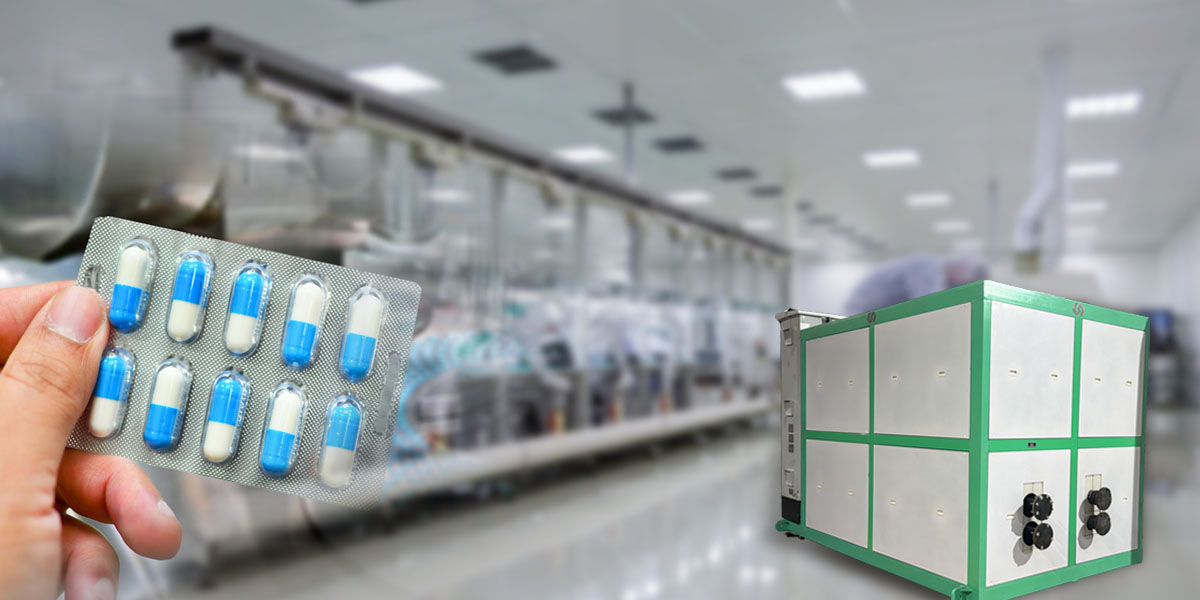
The pharmaceutical sector is under immense pressure to decarbonize while maintaining the ultra-precise thermal environments required for cGMP (Current Good Manufacturing Practice). Traditional steam boilers are no longer the gold standard; they are carbon liabilities.
Trigen DC specializes in bridging this gap. Our High-Temperature Heat Pump (HTHP) technology provides a sustainable, electrified alternative for process heating, allowing facilities to recover waste heat and upgrade it to high-grade thermal energy. By integrating Trigen DC solutions, pharma manufacturers can achieve significant Scope 1 emission reductions without compromising on the rigorous temperature stability required for life-saving drug production.
A High-Temperature Heat Pump (HTHP) is an advanced thermal recovery system designed to provide process heat at levels far exceeding standard commercial HVAC units. While a typical heat pump might struggle to reach 50°C, Trigen DC’s industrial-grade systems are engineered to deliver temperatures between 80°C and 145°C ( 180 Deg C by June 2026).
HTHP systems are the cornerstone of thermal electrification in pharmaceutical manufacturing. They deliver precise, stable thermal control required for critical processes—including chemical synthesis, distillation, drying, and sterilization—while enabling facilities to significantly reduce carbon emissions.
“High-temperature heat pumps (HTHPs) in the pharmaceutical industry deliver precise, stable thermal control (up to 200°C) for synthesis, distillation, drying, and sterilization, while reducing carbon emissions by 70–90%. These systems recover waste heat from process cooling or chillers to generate hot water or steam, improving energy efficiency (COP 2.5–5) and reducing reliance on fossil fuels.”
Unlike conventional heat pumps:
Engineered to generate temperatures up to 180°C, meeting the thermal thresholds required for complex chemical synthesis and large-scale API manufacturing.
Provides consistent, high-grade heat necessary for SIP (Sterilization-In-Place) cycles, equipment autoclaving, and cleanroom thermal stability.
A COP of up to 5 means 1 unit of electrical input can produce up to 5 units of usable thermal energy.
Replacing gas boilers with HTHPs directly reduces Scope 1 emissions. When powered by renewable electricity, facilities can achieve carbon-neutral thermal operations.
Advanced HTHPs address a major portion of industrial heating demand below 200°C, making them highly suitable for pharmaceutical operations.
Use of low-GWP refrigerants such as HFO-1336mzz(Z) and HFO-1234ze(Z) ensures compliance with evolving F-gas regulations.
Designed to replace or augment legacy steam boilers, with ROI often achieved within 18–24 months, depending on local energy economics.
Solutions range from compression heat pumps with internal heat exchangers to specialized high-lift systems for demanding applications.
Reduces dependence on volatile natural gas markets by transitioning to electrified heating.
Temperature stability within ±0.5°C, essential for regulatory compliance and batch consistency.
Recycles rejected heat back into the process, increasing overall plant efficiency.
While electric heaters operate at a COP of 0.95, Trigen DC HTHPs achieve COP values between 2.5 and 5.0 depending on the temperature lift.
Result: 60–80% reduction in energy consumption compared to traditional electric or gas-based systems.
Electrifying process heat eliminates on-site CO₂ and NOₓ emissions. When powered by renewable grid energy, pharmaceutical plants can achieve Net Zero targets for thermal operations.
In addition to core pharmaceutical processes such as sterilization, distillation, and reactor heating, High-Temperature Heat Pumps can also support several utility and environmental control applications within pharmaceutical manufacturing facilities. These applications help improve overall plant efficiency while supporting electrification and decarbonization goals.
Pharmaceutical production areas often require strict humidity control to maintain product stability and comply with regulatory standards. Industrial dehumidification systems commonly use thermal energy for desiccant regeneration and air reheating.
High-Temperature Heat Pumps can provide the required heat for these processes, enabling more efficient humidity control in manufacturing environments.
Many pharmaceutical operations require heated air streams for processes such as drying, granulation, and environmental control within production areas.
HTHP systems can supply thermal energy for:
Air Handling Unit (AHU) reheating.
Process air heating for drying operations.
Hot air supply in controlled manufacturing zones.
This supports the consistent thermal conditions required for pharmaceutical production.
Clean-In-Place systems are used to clean and sanitize pharmaceutical equipment such as reactors, pipelines, and storage tanks. These systems require heated water for cleaning cycles.
High-Temperature Heat Pumps can supply the necessary hot water for CIP operations while improving energy efficiency compared to conventional heating methods.
Water for Injection systems are critical utilities in pharmaceutical facilities. WFI distribution loops often require temperature maintenance and periodic thermal sanitization.
HTHP systems can support these thermal requirements by providing reliable heat for maintaining the required temperature levels within the loop.
Pharmaceutical manufacturing frequently includes solvent recovery systems that use evaporation and distillation processes.
High-Temperature Heat Pumps can provide process heat for these operations and may also be integrated with heat recovery systems to improve overall energy efficiency within the plant.
Solutions developed by Trigen DC can support these additional applications while helping pharmaceutical manufacturers transition toward more efficient and electrified process heating systems.
Feature | Trigen DC HTHP | Gas Boiler | CHP (Cogeneration) | Electric Heater |
Efficiency (COP) | 2.5 – 5.0 | 0.80 – 0.90 | 0.6-0.7 | 0.95 |
Carbon Footprint | Near Zero (with Renewable Power) | High | Moderate to high | Moderate |
Maintenance | Low (Closed Loop) | High (Combustion/Scaling) | Very High | Low |
Energy Source | Electricity | Natural Gas/Oil | Fossil fuel | Electricity |
Don’t let legacy heating systems limit your sustainability goals. Trigen DC provides the engineering expertise to integrate high-temperature heat pumps seamlessly into existing pharmaceutical infrastructure.
Request a Technical Consultation
Download the HTHP Whitepaper
Calculate Your Potential Energy Savings
Yes. For processes requiring temperatures up to 180°C, HTHPs can replace or supplement steam boilers, especially for WFI and CIP systems, while significantly reducing carbon intensity.
Depending on energy prices and carbon incentives, most pharmaceutical facilities achieve full ROI within 2–3 years through energy savings and lower maintenance costs.
The pharmaceutical industry is transitioning from carbon-heavy steam boilers to High-Temperature Heat Pumps (HTHPs) to meet Net-Zero targets without sacrificing cGMP precision. Trigen DC’s HTHP systems deliver stable process heat up to 180°C, boasting a COP of up to 5.0. By recovering waste heat for critical applications like WFI loops, SIP cycles, and distillation, manufacturers can reduce carbon emissions by 70–90% and achieve ROI within 18–24 months. It’s the essential upgrade for electrified, sustainable API and drug manufacturing.