

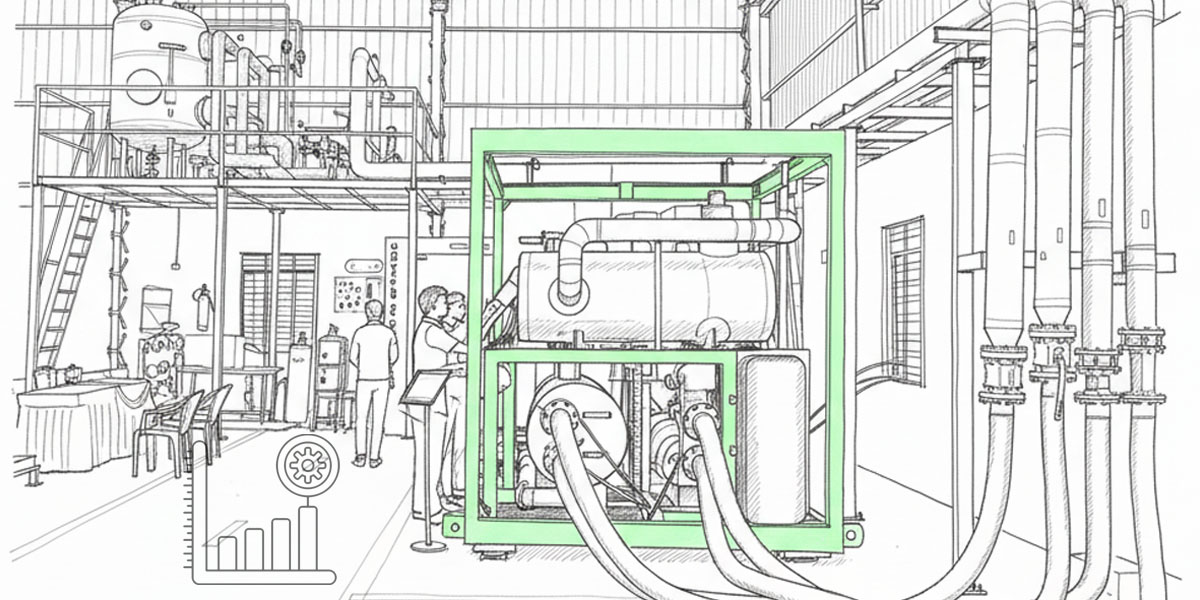
The industrial environment is inherently dynamic. Unlike controlled lab conditions, real-world operations rarely run at a steady state. Production lines fluctuate in production, batch cycles vary, and external factors continually impact demand.
In such conditions, industrial thermal systems are expected to perform with precision—regardless of load variability. But in reality, many industrial high heating solutions struggle to maintain consistent thermal output under fluctuating conditions.
The result? Instability in heat delivery directly impacts production quality, efficiency, and operational costs, as well as all aspects related to this process. Because in industrial operations, stability isn’t optional—it defines productivity and profitability.
Managing high-load environments requires more than just raw power; it requires an understanding of Thermal Inertia. In large-scale industrial scaling, the ability of a system to recover from a massive draw of energy—such as starting a new production batch—determines the “lag” in your processing line. Without adaptive technology, this lag creates a bottleneck that slows down the entire facility.
Most of the industrial processes are not linear. Load variations are a constant across sectors:
Industries such as manufacturing, food processing, textile, and pharmaceuticals operate under continuously changing thermal demands. This makes load fluctuation management a critical factor in system performance.
When systems are not designed to handle variability, the issue arises:
This is where the gap between expected and actual performance becomes visible.
Inconsistent heating directly affects output quality:
For industries relying on precision, even minor thermal deviations can lead to significant production losses.
Unstable systems often compensate inefficiently:
These inefficiencies quietly increase operational costs over time.
Thermal instability also affects equipment health:
Over time, this translates into unplanned downtime and higher capital expenditure.
Conventional systems were not built for dynamic industrial environments:
These systems often rely on overcompensation rather than optimization.
Traditional boilers often suffer from short-cycling—frequently turning on and off to meet minor fluctuations. This doesn’t just waste fuel; it creates massive mechanical wear on burners and heat exchangers. In a high-load environment, short-cycling is the leading cause of premature equipment failure and “energy bleed.”
Another critical limitation is the absence of intelligent control:
This lack of adaptability leads to inefficiencies across operations.
As global markets shift toward Heat Electrification, Trigen DC Heat Pumps work as the bridge between sustainability and performance and industries. By replacing fossil-fuel-dependent systems with advanced heat pumps, industries achieve two goals at once: decarbonization and superior load management.
TRIGeN DC’s heat pump systems for industry are engineered specifically for dynamic industrial conditions. They are built to operate reliably under continuous, high-load environments—ensuring performance does not drop even during peak demand cycles.
These systems are designed to deliver thermal stability in industrial processes:
The focus is on maintaining uniformity—regardless of operational variability.
TRIGeN DC systems incorporate adaptive control mechanisms:
This enables effective high-load heat pump solutions that align output with actual demand.
Beyond stability, Trigen DC heat pump systems are engineered to solve the core operational challenges faced in high-load industrial environments. These are not just heating systems—they function as performance enablers across the entire production ecosystem.
Heat pumps of Trigen DC are capable of delivering consistent high-temperature output required for demanding industrial processes such as:
This ensures that industries do not need to compromise on temperature requirements while transitioning to energy-efficient systems.
One of the key advantages of TRIGeN DC systems is their ability to integrate with existing thermal setups:
This reduces transition risk and allows industries to upgrade without complete system overhauls.
TRIGeN DC systems are equipped with advanced monitoring and control capabilities, enabling:
This transforms thermal systems from static utilities into intelligent, data-driven assets.
Industrial facilities often run 24/7, and TRIGeN DC systems are built to match that intensity:
This ensures operational continuity without thermal interruptions.
By aligning output precisely with demand and eliminating inefficiencies, TRIGeN DC heat pumps help:
Over time, this leads to a measurable improvement in total cost of ownership (TCO).
With increasing regulatory pressure and sustainability targets, industries need solutions that deliver both performance and environmental responsibility.
TRIGeN DC enables:
All while maintaining high-performance thermal delivery required for industrial operations.
Investing in stable thermal systems is no longer just about the current fiscal year—it’s about future-proofing. As energy regulations tighten, the ability to demonstrate precise control over energy consumption becomes a competitive advantage. TRIGeN DC systems ensure that as your production scales, your energy footprint remains optimized and predictable.
Trigen DC heat pump systems are engineered for industries where thermal precision, consistency, and efficiency directly impact output quality, cost, and compliance.
Thermal processes like dyeing, washing, and finishing require consistent temperature control. TRIGeN DC enables:
Highly regulated environments demand precision and repeatability. TRIGeN DC systems ensure:
Energy-intensive processes require reliable and efficient heat delivery. TRIGeN DC delivers:
Quality, safety, and shelf life depend on precise thermal control. TRIGeN DC systems provide:
Precision manufacturing requires tightly controlled thermal environments. TRIGeN DC supports:
Complex manufacturing processes demand adaptable and reliable thermal systems. TRIGeN DC enables:
Operational excellence is built on predictability. When thermal systems deliver consistent performance, processes become more efficient, energy usage becomes optimized, and sustainability goals become achievable. Stability connects directly to efficiency, profitability, and long-term operational resilience.
Industrial environments will always be dynamic. Load fluctuations are inevitable. But performance inconsistency doesn’t have to be. By adopting advanced, adaptive systems like TRIGeN DC’s industrial thermal systems, businesses can ensure stable, efficient, and reliable operations—regardless of demand variability.
If your current system struggles with fluctuating loads, it may be time to rethink how thermal performance is delivered.
Contact us. Connect with TRIGeN DC to assess your current thermal system and explore solutions designed for consistent, high-load industrial performance.
Industrial operations rarely run at constant load, making thermal stability critical. Traditional systems struggle with fluctuations, leading to inefficiency and maintenance issues. TRIGeN DC’s advanced heat pump systems handle dynamic loads, ensuring consistent output and reliable performance under all conditions.