

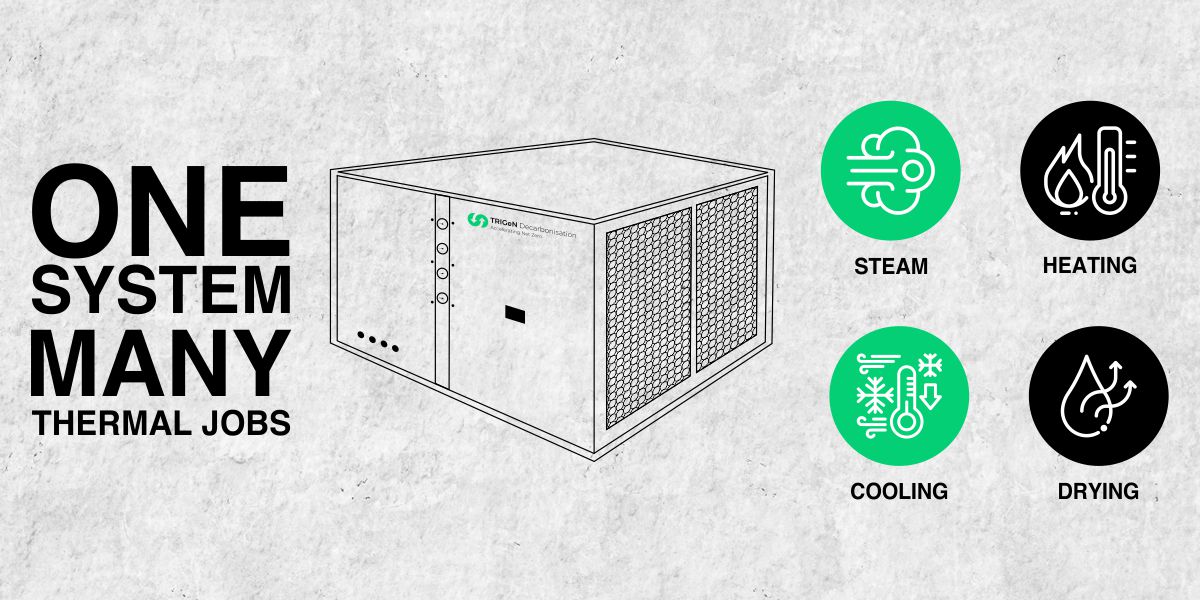
Modern industrial facilities are transitioning from “Thermal Fragmentation” to “Unified Architecture.” By consolidating isolated boilers, chillers, and dryers into a single, electrified heat pump platform, plants can achieve simultaneous 145°C steam and 7°C cooling. This integrated approach reduces maintenance overhead by 60%, eliminates on-site combustion, and provides a documented 70% reduction in energy OPEX, delivering a scalable path to Net-Zero manufacturing.
Walk through any major industrial plant—be it a textile giant in Tirupur, a pharmaceutical conglomerate in the Baddi valley, or a food processing powerhouse in the heart of the Midwest. You will find a common, expensive pattern: The Thermal Silo.
In one wing of the building, a central boiler room roars with the aggressive, hungry hum of combustion. It consumes massive volumes of coal, diesel, or gas to push high-pressure steam through miles of lagging pipes. Walk fifty steps toward the production floor, and the atmosphere shifts abruptly to the mechanical scream of outdoor chillers. These machines vibrate against their concrete pads, working with straining force to rip heat out of a production line—only to vent that precious, expensive energy into the sky in a shimmering haze of waste.
On an engineering blueprint, this looks functional. In the reality of a 2026 economy, it is an operational liability.
Every additional system—the standalone dryer on the mezzanine, the isolated hot water tank in the wash-down area—introduces a new layer of risk. A boiler failure doesn’t just stop steam; it paralyzes the entire facility. A chiller that requires emergency servicing means a maintenance team, a rush for imported spare parts, and downtime that was never budgeted. When you multiply this across four independent thermal systems running simultaneously, you aren’t just managing infrastructure. You are managing a house of cards.
The concept of consolidating multiple thermal utilities into one intelligent platform is not just an engineering aspiration; it is a direct response to the fundamental laws of thermodynamics.
In the legacy model, heat and cold are treated as enemies. In a manufacturing environment, however, they are two sides of the same coin. A food processing plant needs 140°C steam for pasteurization and 4°C chilled water for storage—often at the exact same moment. A textile unit needs 130°C hot air for drying while simultaneously requiring process heating for chemical treatment baths.
When these systems run separately, energy is consumed in a vacuum. The heat rejected by the cooling process is treated as garbage. The cold that could be recovered from condensation is ignored. There is no coordination, no shared intelligence, and no mechanism for one process to benefit from the output of another.
An integrated heat pump architecture changes this at the foundational level. It creates a “Thermodynamic Dialogue.” Instead of treating each thermal requirement as a separate problem, it treats them as interconnected outputs of a single, elegant energy cycle. It is a system where the heat “stolen” from a cooling jacket becomes the very input for the steam line. Every unit of electricity consumed is squeezed, recycled, and forced to work harder across the entire thermal load.
TRIGeN DC’s integrated platform is not a bundled product offering or a collection of machines in a box. It is a single, unified system engineered to deliver a symphony of thermal outputs simultaneously from one platform.
For decades, the “Achilles’ heel” of heat pump technology was its temperature ceiling. Conventional systems could provide lukewarm water, but they couldn’t touch the high-grade heat required for heavy industry. TRIGeN DC has shattered that ceiling.
Our Steam Generating Heat Pumps (SGHP) produce pressurized, dry process steam at temperatures up to 145°C. This is not “supplemental” steam; it is primary process steam. By utilizing advanced refrigerant cycles and multi-stage vapor injection, we deliver this steam at an operating cost of approximately ₹1.45 per kilogram. This is achieved at efficiency levels (COP) three to four times higher than the most optimized fossil fuel boilers.
For industries where moisture is the enemy, our High-Temperature Heat Pumps and Dryers operate at temperatures up to 130°C. But intensity is nothing without control. In a garment facility or an electronics plant, precision temperature control ensures that product quality is maintained during 24×7 continuous duty. The hot air delivered is consistent, uniform, and—crucially—free from the soot and particulates of biomass combustion.
The Combined Heating and Cooling (CHC) system is the clearest demonstration of what integration makes possible. A single TRIGeN DC system delivers hot water or steam from one circuit and chilled air or water from another—simultaneously.
Imagine a dairy plant: the system pulls heat out of the milk (cooling it) and “lifts” that same energy into the water line to feed the sterilization cycle. You are achieving two massive industrial outcomes for the price of one electrical input. This dual utility directly accelerates return on investment while reclaiming valuable real estate on the plant floor.
Thermal energy must be resilient. Many industrial facilities operate in “Thermal Deserts”—high-altitude regions or harsh, sub-zero climates where standard heat pumps lose their breath.
TRIGeN DC is currently the only company in the world commercially manufacturing and deploying heat pumps capable of operating at ambient temperatures as low as -35°C. This opens the door for industrial electrification in geographies that were previously tethered to coal and oil out of sheer necessity. It ensures that your steam line doesn’t falter when the winter temperature drops.
The transition to a unified platform is ultimately about a shift in power—moving the plant manager from the role of an Energy Consumer to an Energy Commander.
When a single intelligent system manages your steam, heating, cooling, and drying, the operational complexity of the facility evaporates.
Smart auto-restart, thermal hold capabilities, and cloud-based dashboards provide a level of visibility that was impossible when five systems from five different vendors were running independently across the same facility.
The conventional industrial logic has always been: Need more steam? Add a boiler. Need more cooling? Add a chiller. The result is a facility that grows increasingly complex, increasingly expensive, and increasingly difficult to decarbonize.
TRIGeN DC inverts this logic. By replacing five systems with one, facilities achieve three goals in a single transition: Electrification, Decarbonization, and Operational Simplification. Whether it is the Epic Group in textiles, a pharmaceutical giant requiring ±0.5°C stability, or a paper mill requiring continuous drying, the result is the same: A cleaner, leaner, and more profitable industrial floor.
Industrial plants do not have a thermal problem; they have a systems problem. The era of the “Add-On” is over. The next era of industrial energy looks like smarter, integrated infrastructure that does everything thermal—without burning a single drop of fuel.
TRIGeN DC’s integrated heat pump architecture is that future.
Ready to consolidate your thermal utilities and command your energy? Talk to TRIGeN DC at trigendc.com or call +91 95992 06761.
Modern industrial plants are moving away from inefficient, isolated boilers and chillers toward Unified Thermal Architecture. By integrating steam, heating, cooling, and drying into a single electrified heat pump platform, facilities can eliminate on-site combustion and drastically simplify operations.